Republic India Issues
Throughout history, the right to Coinage and Currency and issues of sovereignty
have been curiously conjoined, emotionally if not rationally; these issues stimulate
debate even today.
The transition of currency management from colonial to independent India was a reasonably
smooth affair. Midnight, August 15, 1947 heralded Indian independence from colonial
rule. The Republic, however, was established on 26th January, 1950. During the interregnum,
the Reserve Bank continued to issue the extant notes.
Government of India brought out the new design Re 1 note in 1949.

Government of India - Rupee One
Symbols for independent India had to be chosen. At the outset it was felt that the
King's portrait be replaced by a portrait of Mahatma Gandhi. Designs were prepared
to that effect. In the final analysis, the consensus moved to the choice of the
Lion Capital at Sarnath in lieu of the Gandhi Portrait. The new design of notes
were largely along earlier lines.
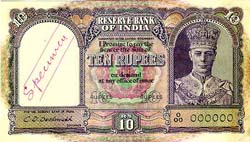
Rupees Ten - King's Portrait
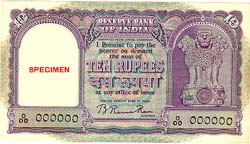
Rupees Ten - Ashoka Pillar
In 1953, Hindi was displayed prominently on the new notes. The debate regarding
the Hindi plural of Rupaya was settled in favour of Rupiye. High denomination notes
(Rs 1,000, Rs. 5,000, Rs. 10,000) were reintroduced in 1954.
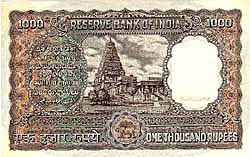
Rupees One Thousand - Tanjore Temple
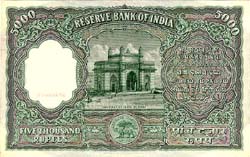
Rupees Five Thousand - Gateway of India

Rupees Ten Thousand - Lion Capital, Ashoka Pillar
The lean period of the early sixties led to considerations of economy and the sizes
of notes were reduced in 1967. In 1969 a commemorative design series in honour of
the birth centenary celebrations of Mahatma Gandhi was issued depicting a seated
Gandhi with the Sevagram Ashram as the backdrop.

Rupees One Hundred - Commemorative Design
Cost benefit considerations prompted the Bank to introduce Rs. 20 denomination notes
in 1972 and Rs. 50 in 1975.

Rupees Twenty

Rupees Fifty
High denomination notes were once again demonetised in 1978 for the same reasons
as the 1946 demonetisation. The 1980s saw a completely new set of notes issued.
The motifs on these notes marked a departure form the earlier motifs. The emphasis
lay on symbols of Science & Technology (Aryabhatta on the Rs 2 note), Progress
(the Oil Rig on Re 1 and Farm Mechanisation on Rs 5) and a change in orientation
to Indian Art forms on the Rs 20 and the Rs 10 notes. (Konark Wheel, Peacock).
Management of Currency had to cope with the rising demands of a growing economy,
together with a fall in purchasing power. The Rupee 500 note was introduced in October
1987 with the portrait of Mahatma Gandhi. The water mark continued to be the Lion
Capital, Ashoka Pillar.
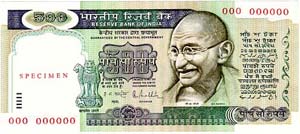
Rupees Five Hundred
Mahatma Gandhi Series
With the advancement of reprographic techniques, traditional security features were
deemed inadequate. It was necessary to introduce new features and a new 'Mahatma
Gandhi Series' was introduced in 1996. A changed watermark, windowed security thread,
latent image and intaglio features for the visually handicapped are amongst the
new features.

Rupees Ten : Size 137 x 63 mm

Rupees Fifty : Size 147 x 73 mm

Rupees One Hundred : Size 157 x 73 mm

Rupees Five Hundred : Size 167 x 73 mm

Rupees One Thousand : Size 177 x 73 mm

No comments:
Post a Comment